 Veronica Romero

Redefining growth: designing a scalable growth framework
The starting point
- Core competencies, for everyone
- Technical competencies, per discipline
Metalab’s company-wide growth framework was two years old when I took this on. Ten core competencies applied to all 140 employees, and six disciplines (Design, Engineering, Product Management, Research, Talent Acquisition, and Resource Management) each layered a technical track of 6 to 12 more on top.
That added up to close to 300 line items across about 45 roles. At that depth it was too heavy for everyday use, or even for monthly conversations between managers and their reports. In practice it worked as a performance review tool: people opened it when someone needed to be evaluated, and closed it until the next cycle.
The challenge
Design leadership asked me to update the design technical competencies. Managers were struggling to have useful growth conversations, designers couldn’t see what progression looked like in their role, and the technical competencies no longer reflected how the team worked.
I was hearing the same friction from other departments, so before scoping anything I wanted to know whether this was a design problem or a company problem. I checked Lattice data, both pulse surveys, and exit feedback with People Ops.
Making the case
- Effective: 33%
- Neutral: 48%
- Not effective: 19%
The data showed the problem went well beyond design:
- Only 9% of employees had an active growth plan in Lattice.
- Only 33% of managers rated the review process as effective.
- Sentiment about growth had dropped below the previous two years.
- Exit feedback from the prior six months kept coming back to career plateauing. People leaving told us it was easier to land a senior role somewhere else than to get promoted here.
Fixing design alone wouldn’t have solved it. Every role, design included, was evaluated on the same core competencies, and that was where much of the friction sat. Updating the design track while leaving the core untouched would have left two layers that didn’t fit together. I recommended a full overhaul to Design Leadership and People Ops, framed as a retention and morale risk for the whole company. That secured the investment and made it a company objective.
Defining success
Once leadership agreed on the problem, I worked with People Ops to turn it into a company objective with three key results.
Objective: Build the internal conditions that make Metalab a place people grow so that career progression happens from within rather than through attrition and backfill.
- KR1: 100% of employees have an active growth plan in Lattice within 90 days of launch
- KR2: Manager confidence increases from 33% to above 60%
- KR3: Reduce attrition tied to growth stagnation. Promotion pathway is clear and achievable from within.
Discovery and audit
I ran 20 discovery sessions with employees, managers, and department leads. I wanted to know where the framework got in the way, what it was missing, and why nobody used it between review cycles.
At the same time, I audited every line item. I adapted a sensemaking approach from Abby Covert’s work and sorted each item by the signal it was supposed to carry:
- Is it a skill, a behaviour, or an outcome?
- Is it within the employee’s control?
- Can a manager reliably evaluate it?
Applying those questions by hand to close to 300 items, and then to every new draft, wasn’t realistic. I built AI-assisted classification rules around them so the same logic held every time.
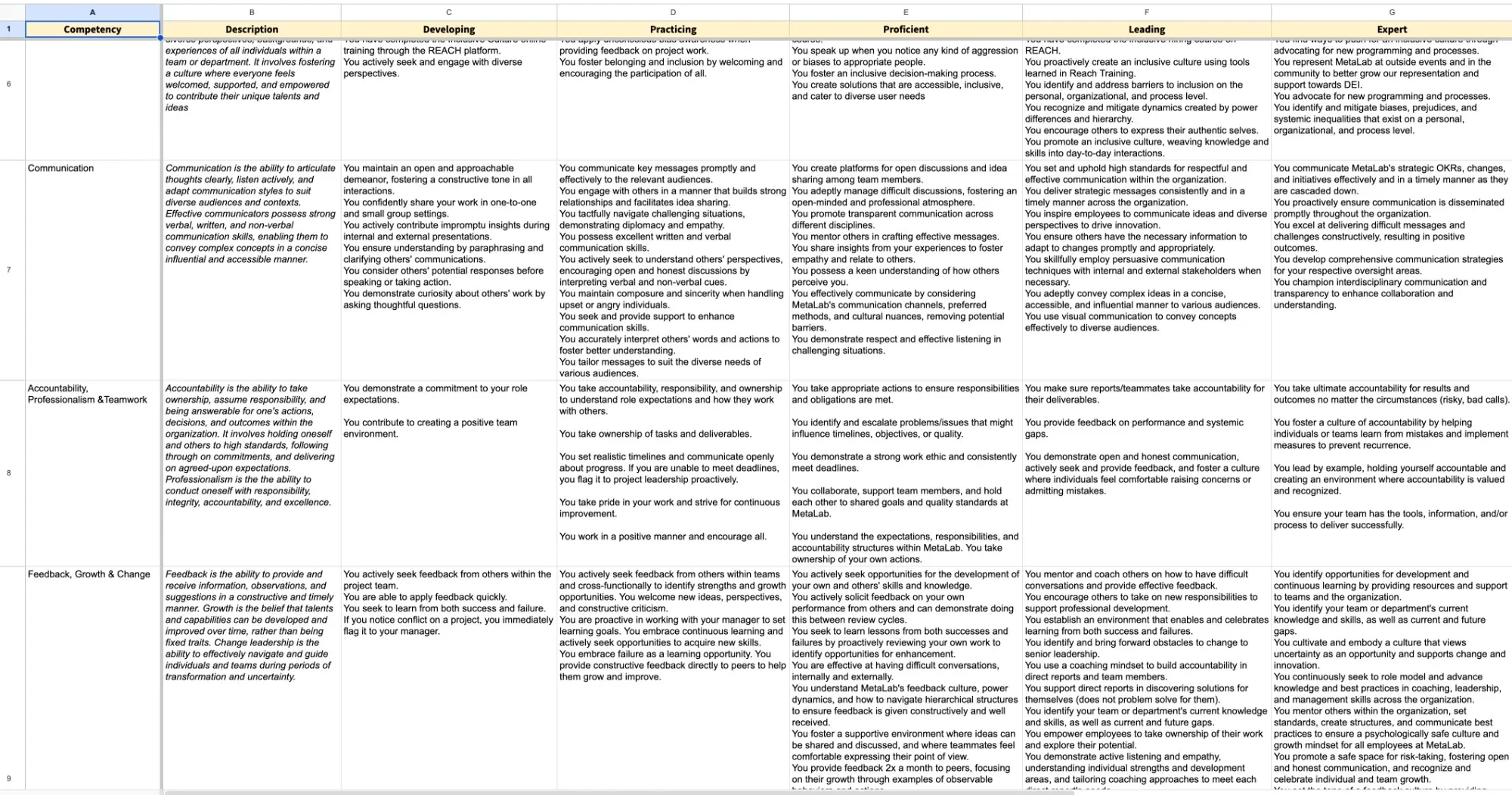
Where the framework was failing
Across the organization
- Overwhelming volume: with close to 300 points, growth conversations became checklist reviews, and people felt expected to excel at everything.
- Misaligned weight: every competency carried equal weight, regardless of role or level.
Within the design team
- The technical competencies no longer reflected how design work had evolved.
- Brand and product designers were evaluated against identical criteria, leaving deep craft specialists undervalued.
Consolidating the core
The principle I kept coming back to was clarity over completeness. The framework didn’t need to list everything someone could do. It needed to give people enough guidance to start a real conversation.
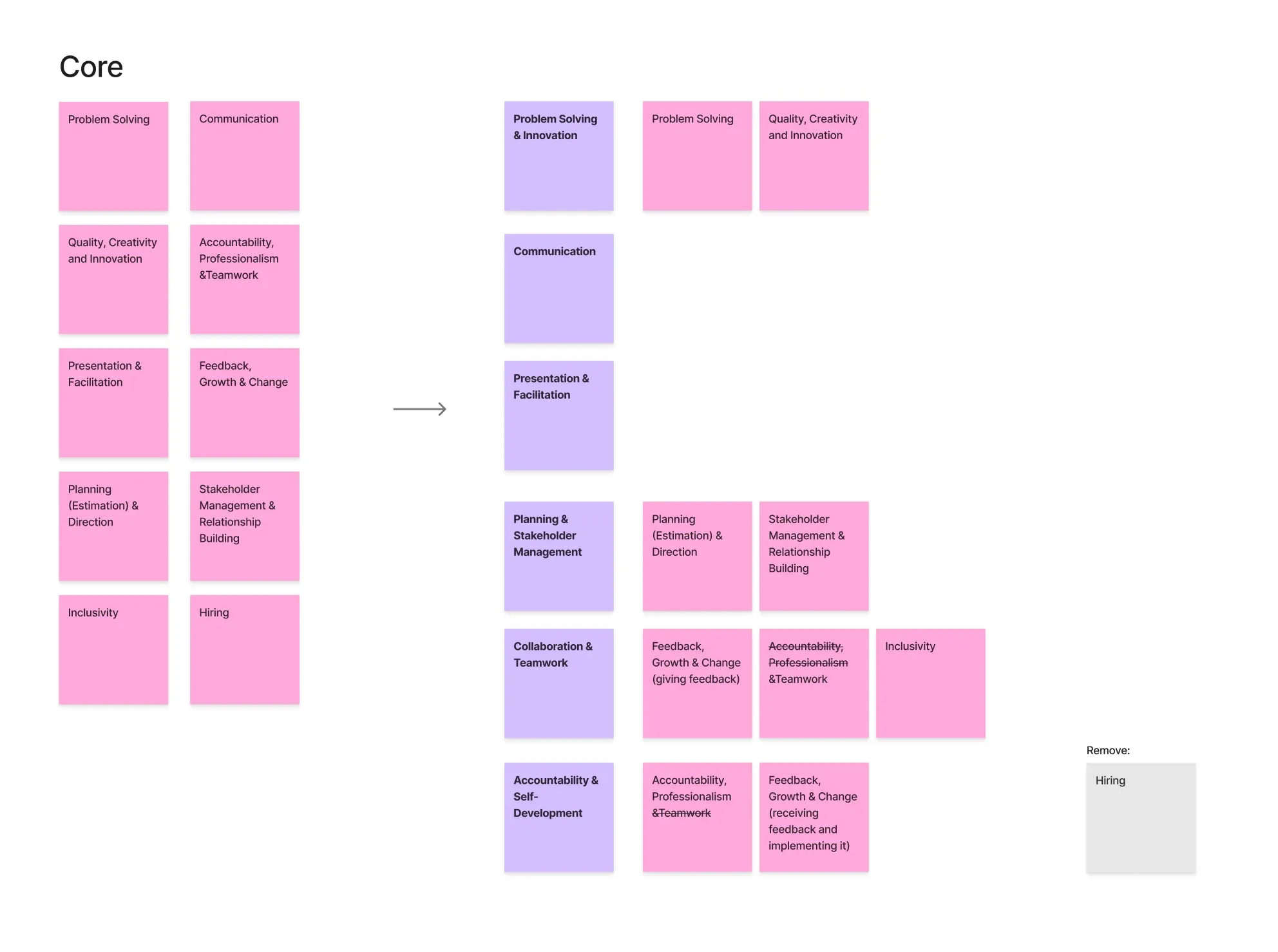
I cut the core competencies from ten to six by merging the ones that overlapped and making sure each one left measured something distinct. Hiring came out of the core entirely.
I rewrote each competency as 3 to 5 observable signals per level, grouped by subsection instead of long paragraphs. Tighter level definitions left managers fewer judgment calls to make, and the shorter format meant I could actually keep it up to date.
Modernizing the design framework
Design needed more than consolidation. The discipline had changed a lot in two years, and the framework still described the old version of the job. I brought in two long-tenured principal designers for their read on our project types, and kept final decision-making.
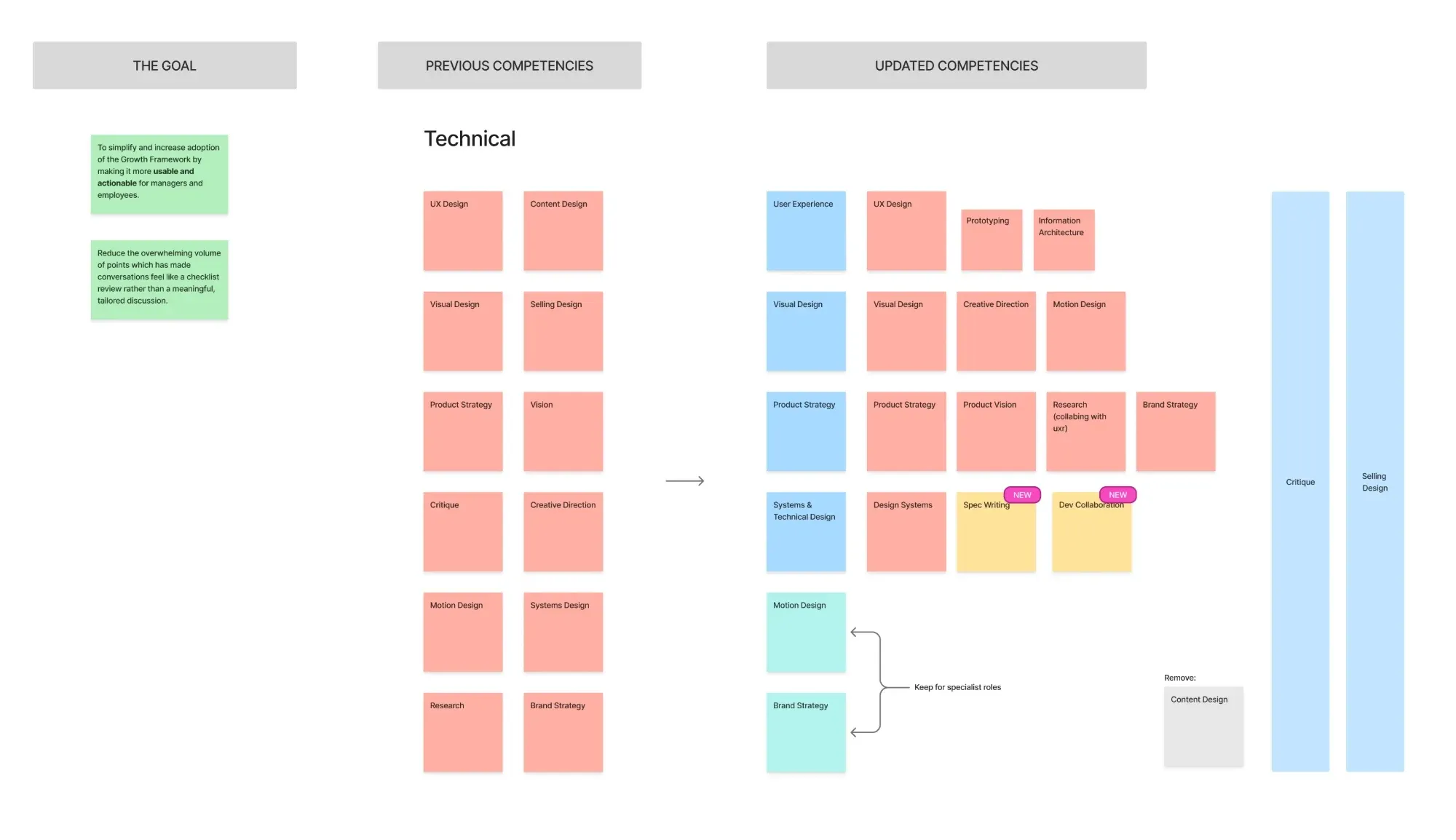
- Specialization: consolidated twelve technical competencies into four shared ones (user experience, visual design, product strategy, and systems and technical design), and kept motion design and brand strategy as specialist competencies for those roles. Each competency lost 50 to 75% of its content.
- Unmeasured expectations: formalized work that was expected but never assessed, including developer collaboration and specification writing.
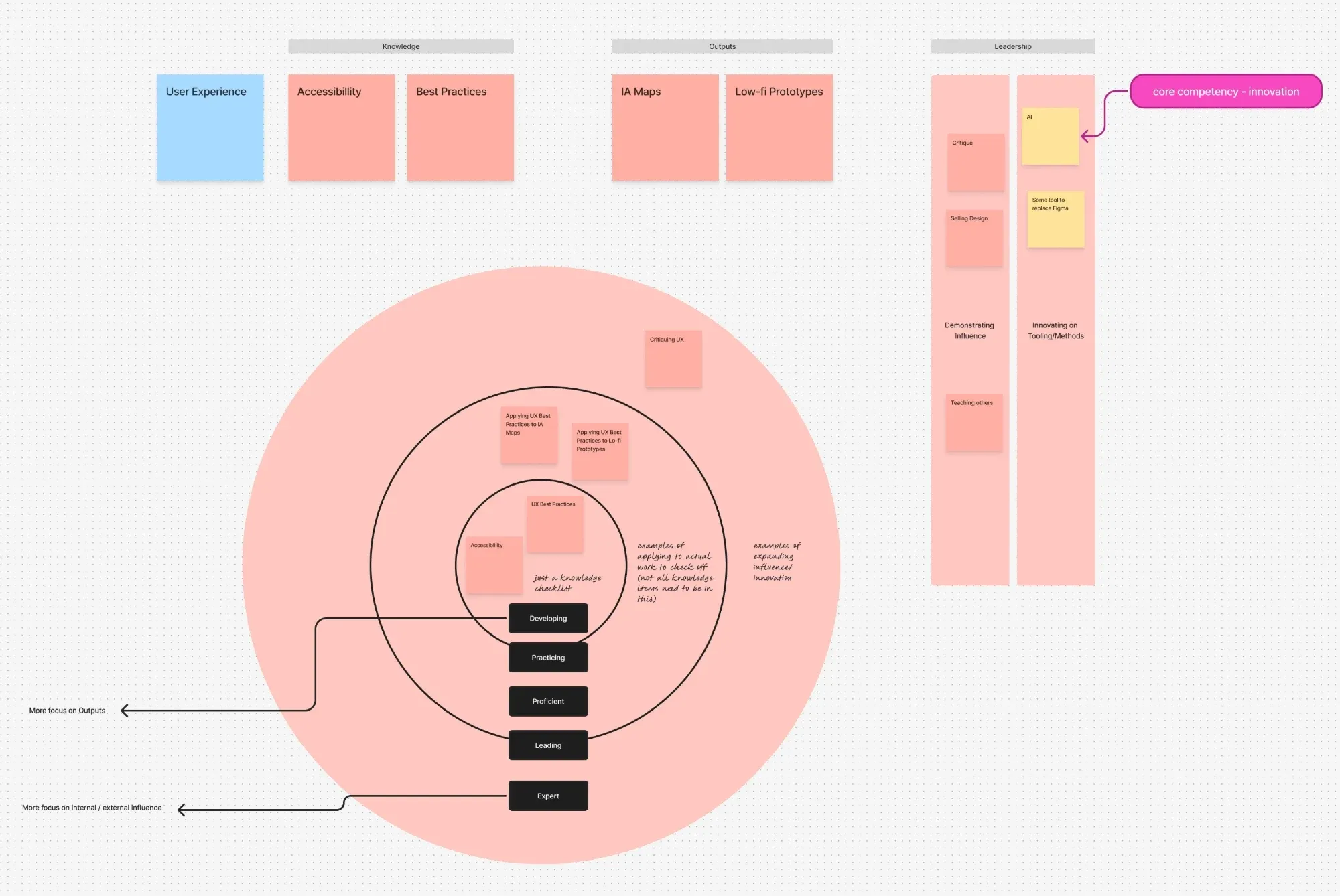
- Level design: redefined levels around an expanding sphere of influence rather than increasing output. Critique and selling design moved from standalone competencies into how progression is described at every level.
Treating the framework like a product
A spreadsheet is still a spreadsheet, no matter how well it’s written. Designers spend their whole day in Figma, and they had no interest in checking yet another tool. What they wanted was somewhere to add notes, paste in examples of their work, and build a case for their growth over time.
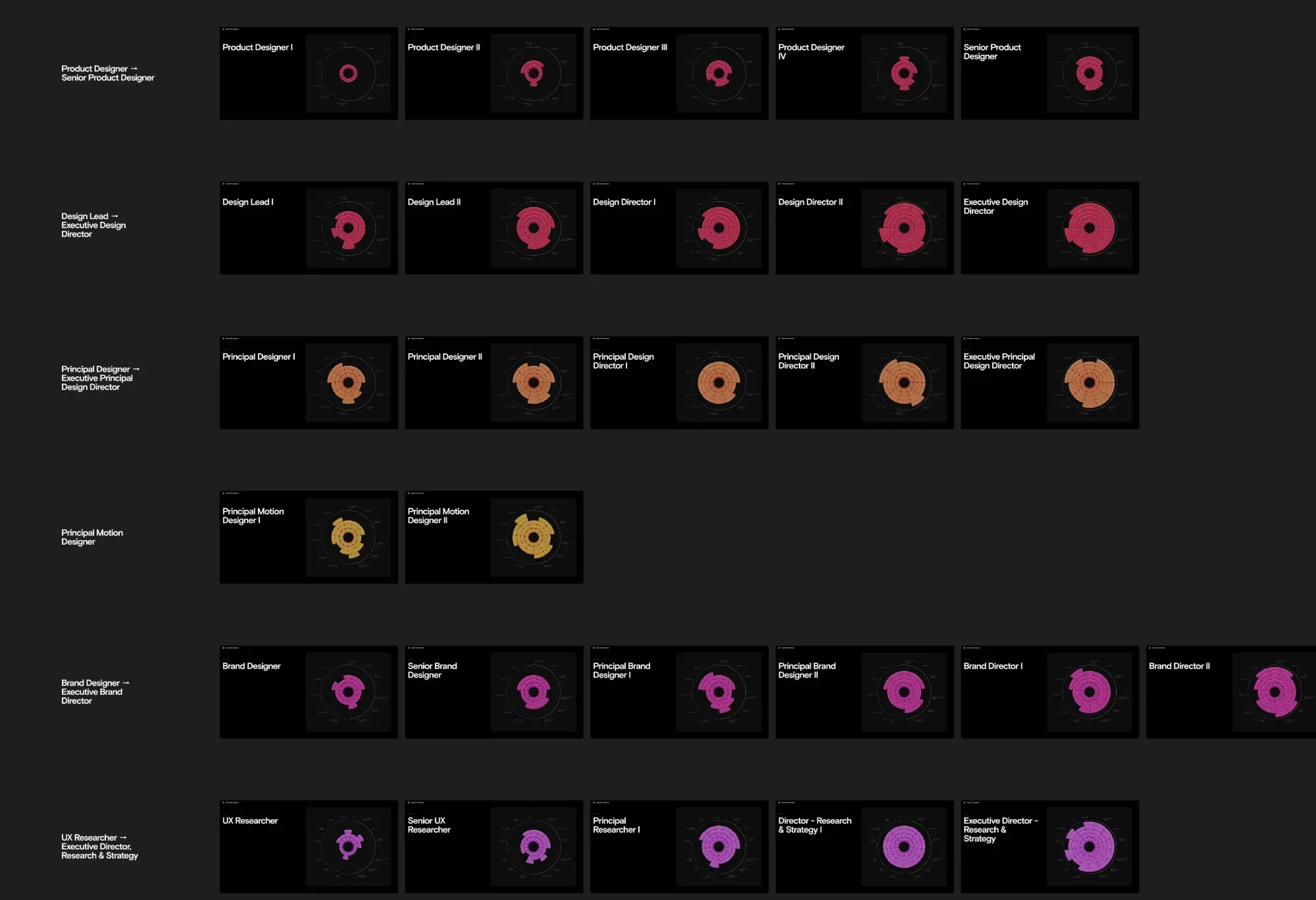
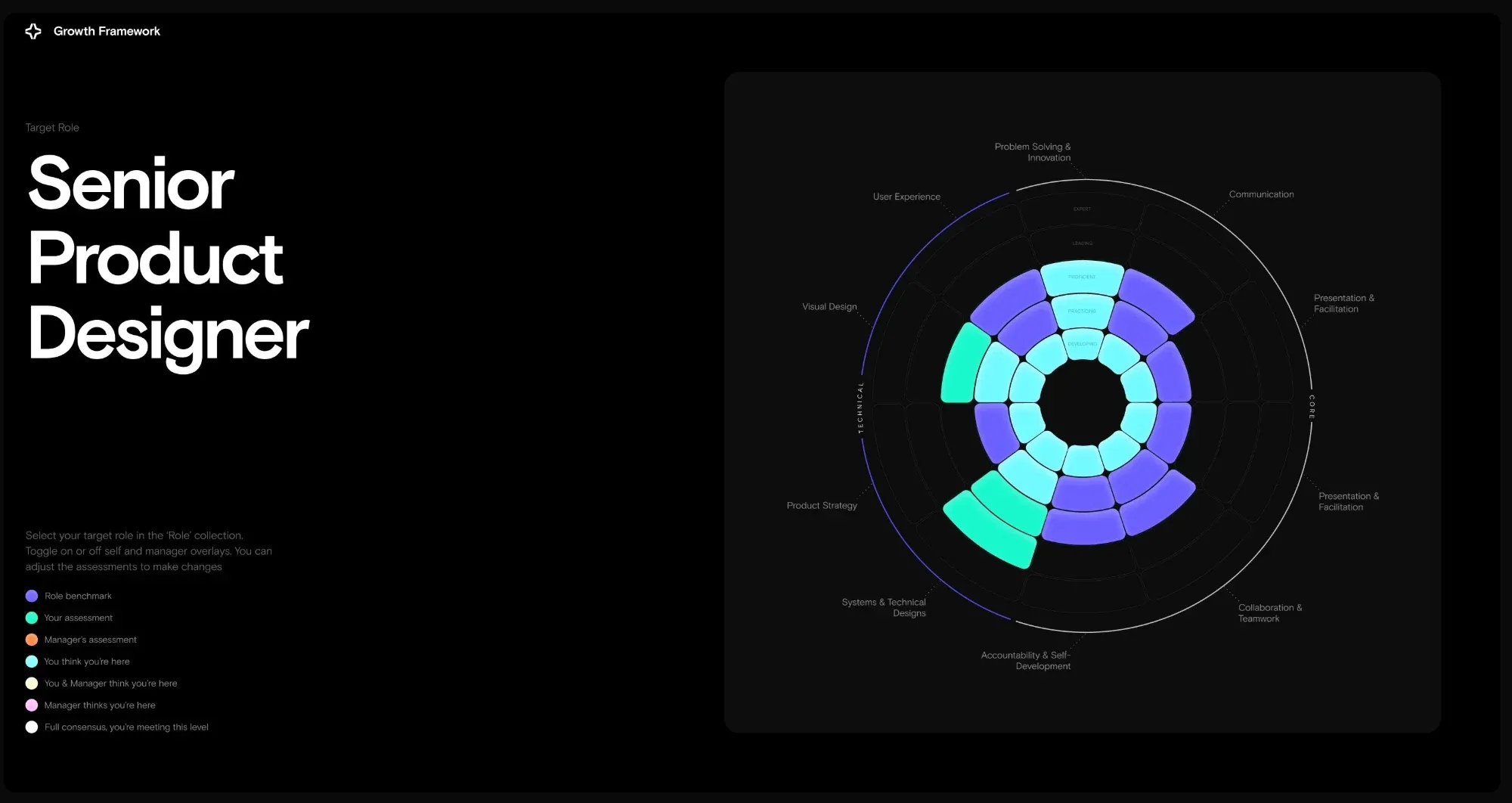
I wrote the brief for a visual companion in Figma, sitting alongside the Notion documentation and the framework in Lattice, and partnered with a designer to build it in the two weeks of their time I had. It mapped every design career path and gave designers and managers a radial self and manager assessment they could fill in and compare, built from the designer’s own work.
Rollout
Once executives signed off, I automated the Lattice integration through Zapier, introduced the changes in existing leadership meetings rather than adding new ones, and committed to updates before every review season.
Timing was the decision that mattered most. I set aside September for people to get familiar with the framework, so nobody was reviewed against something they had never used.
Results
- 65% of employees had an active growth plan within 90 days of launch, up from 9%, against a target of 100%.
- 68% of managers rated themselves confident in the review process, up from 33%, exceeding the 60% target.
- 9 promotion packages cited framework evidence in the first cycle after launch.
Growth plans fell short of the 100% target. Attrition couldn’t be measured reliably within the project window, but the work exposed that promotion decisions weren’t referencing competency evidence. I raised it with People Ops and leadership, and managers now cite competency expectations in every promotion case.
Reflection
Looking back, there are two things I’d do differently.
Build alliances earlier. The people with the most at stake weren’t department heads but the leads and managers having weekly career conversations with earlier-career reports. I found them mid-project, and next time I’d bring them in from the start.
Design for scale from the start. I scoped the Figma companion as a design-only pilot. I’d push for more time up front and build it for every department from day one.